
iPerform Education | Education Watch | October 2026
A survey of Harvard faculty conducted by the university’s student newspaper, The Harvard Crimson, suggests that concern about artificial intelligence (AI) in teaching has grown over the past year. As generative AI becomes a common learning tool for students, instructors are reconsidering how to assess learning and establish appropriate rules for its use in their courses.
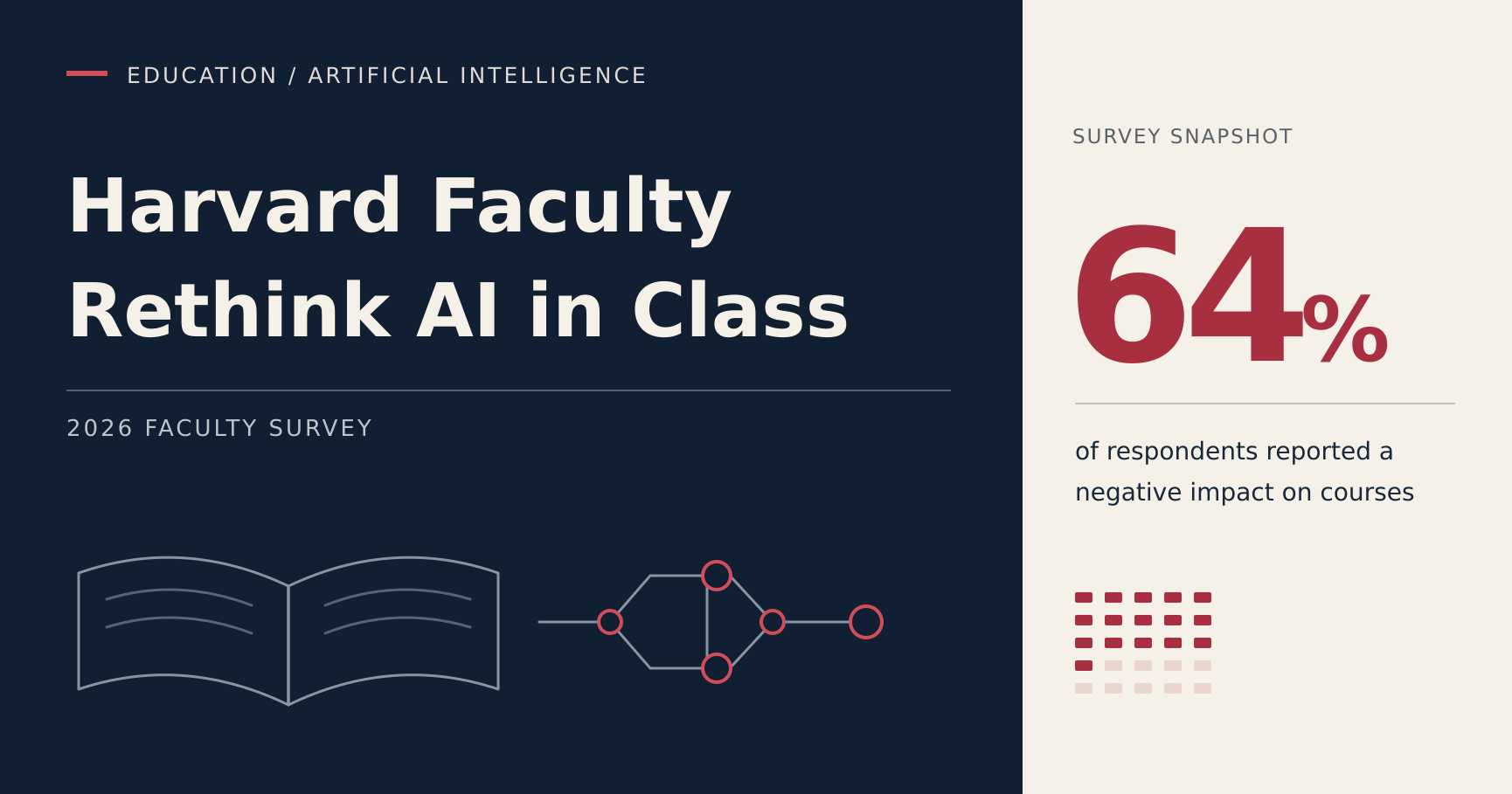
The Crimson published the results of its annual faculty survey on September 14, 2026. Sixty-four per cent of respondents said AI had had a somewhat or very negative impact on the courses they taught, up 22 percentage points from 42 per cent the previous year.
The findings highlight a challenge facing university instructors: when students can use AI to complete parts of their writing, analysis and research, how can instructors determine whether they have genuinely understood the material?
Nearly Nine in Ten Respondents Had Received Work They Believed Might Be AI-Generated
The survey covered faculty members in the three divisions of Harvard’s Faculty of Arts and Sciences (FAS), as well as the John A. Paulson School of Engineering and Applied Sciences (SEAS).
The questionnaire was sent to more than 1,400 faculty members and received 463 responses: 292 complete and 171 partial. Participation was voluntary, so the results reflect the views of respondents and should not be treated as representative of all Harvard faculty.
Nearly nine in ten respondents reported receiving student work that they were certain, or suspected, had been generated by AI.
In a separate question, however, only 64 per cent said they were somewhat or very confident in their ability to distinguish work students had completed independently from AI-generated work.
That figure measures instructors’ confidence in their own judgement. The survey did not test how accurately they could identify AI-generated content.
As AI becomes capable of quickly producing well-structured, fluent writing, a finished assignment alone may reveal little about how much thinking and learning went into it.
Course Policies on AI Are Becoming More Explicit
Growing concern about AI is also reflected in changes to course policies.
According to the survey, the proportion reporting no explicit policy on AI use fell from about 10 per cent the previous year to 3.5 per cent. The proportion reporting a complete ban rose from 20 per cent to 24 per cent.
At the other end of the spectrum, the proportion allowing unrestricted AI use declined from 8 per cent to 4 per cent.
The most common approach was to permit AI use under specified conditions. About 34 per cent of respondents reported strict restrictions, while another 35 per cent reported some restrictions, for a combined total of approximately 69 per cent.
These findings suggest that respondents are setting clearer boundaries around AI use, although policies continue to vary considerably from one course to another.
The Crimson also noted that instructors’ self-reported policies did not appear to align fully with the findings of its separate analysis of approximately 600 fall courses.
That discrepancy is a reminder that policies described in a faculty questionnaire may not capture the full range of arrangements across courses. The sources and methods behind the findings matter when interpreting them.
Instructors Are Rethinking Exams and Assignments
As AI-generated content becomes harder to identify, some Harvard instructors are changing how they assess students.
The Crimson reported that some had returned to in-person, paper-based exams, requiring students to complete their answers independently in the classroom.
Others required students to submit assignments through Google Docs and retain their version histories, giving instructors a way to examine the writing and revision process.
One course in Harvard’s Department of Government also embedded hidden instructions in a take-home final exam in an attempt to identify students who submitted exam questions directly to an AI tool.
These approaches illustrate the different assessment methods instructors are exploring. Each has limitations. A document’s version history, for example, can offer some evidence of the writing process, but it cannot establish on its own that a student completed the work entirely independently.
On academic integrity, 12 per cent of respondents said they had formally referred a student to Harvard’s Honor Council or Administrative Board for unauthorized AI use, a modest increase from approximately 10 per cent the previous year.
This is the proportion of respondents who had made a formal referral. It is not a measure of the prevalence of AI-related misconduct among students.
Harvard Is Also Expanding AI Education
Alongside growing faculty concern, Harvard has been taking steps to help students learn about and understand AI.
In the spring 2026 term, Harvard College introduced a required AI learning module throughout its Expository Writing curriculum.
The module had three components, covering how large language models work, AI’s implications for education, and issues such as environmental impacts, privacy, copyright and misinformation.
A small number of first-year students who fulfilled their writing requirement through Humanities 10 did not take this module. That course had its own approach to teaching about AI.
Separately, Harvard’s Faculty of Arts and Sciences announced plans in April 2026 to introduce access to Anthropic’s Claude, including the coding assistant Claude Code.
According to reporting at the time, the faculty had not finalized a timetable for a full rollout and was considering allowing instructors to request access for individual courses.
The same reporting indicated that FAS planned to change access arrangements for its faculty-wide ChatGPT Edu pilot after June 2026. Continued access would require administrative and budget approval, while existing access to Google Gemini would remain unchanged.
According to reporting in September 2026, Harvard College Dean David J. Deming had also told students in an email that he hoped to establish a College-wide AI policy by the end of that academic year, providing more consistent guidance for students and instructors.
Together, these initiatives show Harvard pursuing AI education, changes to assessment and clearer rules for AI use. Helping students use new tools effectively while maintaining academic integrity and the quality of teaching remains an ongoing challenge.
What Does This Mean for Students Preparing to Study Abroad?
The Harvard survey offers a useful reminder: even within a single university, rules on AI can differ from course to course.
Some courses permit AI use under specified conditions, others impose strict limits, and some prohibit generative AI altogether.
Harvard College’s Office of Undergraduate Education (OUE) requires instructors to explain their policies on generative AI clearly to students and advises them to publish these policies on Canvas, the course learning platform.
Students should read each course syllabus carefully at the start of the term to understand which uses of AI are permitted. If a policy is unclear, they should ask their instructor before using AI or submitting an assignment.
Students also need to be able to explain their own work independently.
Whether or not they use AI as a learning aid, they should be able to describe their research methods, reasoning and conclusions. Keeping records of research, writing and revisions can help them organize their thinking and, when needed, explain how they developed their work.
The survey shows that universities’ approaches to AI are still evolving. Instructors are seeking effective ways to assess learning, while institutions continue to develop AI education and related policies.
For students preparing for university, learning to use AI tools, understanding the rules in each course and maintaining the ability to think and learn independently will all be important parts of their education.
Sources
- The Harvard Crimson, September 14, 2026. More than 60 Percent of Harvard Faculty Say AI Harms Their Courses
- The Harvard Crimson, April 23, 2026. Harvard College Adds Required AI Module to Expository Writing Curriculum
- The Harvard Crimson, April 28, 2026. FAS Plans to Grant Access to Anthropic’s Claude, Phase Out ChatGPT Edu
- Harvard Office of Undergraduate Education. Generative AI Guidance
Survey methodology: The Harvard Crimson sent the questionnaire to more than 1,400 faculty members between April 29 and May 22, 2026. It received 463 responses, including 292 complete and 171 partial responses. Participation was voluntary, and the number of valid responses may differ by question. Comparisons between 2025 and 2026 describe differences between two surveys; they should not be interpreted as changes in the views of the same individual faculty members.
This article provides general education information. For current AI policies and course requirements, consult the latest official guidance from the university concerned.